One of the projects we do is a "found sound" project. Using the internet, we search for wave files that we can use and incorporate them into original compositions.
Here are some human generated sounds that work quite well. Other sounds can be found in the following categories-human, natural, animal, music and entertainment at amazing sounds.
Showing posts with label ipod. Show all posts
Showing posts with label ipod. Show all posts
Saturday, April 26, 2008
Finding Cool Wave Files


Tuesday, February 26, 2008
I-pods, Cell Phones and PDA's in The Classroom
Some schools have declared war on i-pods, cell phones and portable electronic devices. They are seen in these places as a distraction to learning and "education" in general.
Like the war on terrorism, I don't believe this is a winnable war. For three reasons, at least:
1- Teens like music
2- Teens are social to the core (cell phones allow constant and instant communication with one's BFF's)
3- The technologies are here to stay because they are profitable to the companies that make them.
Calculators used to fall into this category. They were a threat and a nuisance....Until!
Until a use was declared within education circles. Someone convinced others within Academia that calculators could, indeed, be used as an enhancement to the educational process. Now, of course, they are ubiquitous.
The problem as I see it is not that students own and use the aforementioned devices. The problem is that ALL students are not using them. If we knew that ALL students owned them, we could require that they be brought to class and used to enhance the learning process.
Imagine:
"OK, the first one to text me the correct answer, gets to ask the next question!"
"OK, take out your ear-buds and using your PDA, login to the school network, go to the Student Network Folder and find a link called Beethoven 1. Listen to the first 2 minutes of Beethoven's 1st Symphony. When you're done, use PDA to do a Google search about classical vs. romantic music. Using your PDA, write a blog post about why Beethoven's Symphony was ground-breaking. E-mail me the link to the post. If you have any questions, text me or send me an e-mail..I'll respond immediately."
or
"OK, tonight, I want you to rip one of your parent's Cd's into your music collection. Choose one you like and that you can connect to the subject of this class in some way. Load it onto your i-pod. We'll listen to a few tomorrow and discuss the relevance of the song to the subject of this class"
Etc...
It's not a war. It's an opportunity. At least it can be.
cross posting from Another Brick In The Wall
Friday, February 01, 2008
Online Music Is Here To Stay
Despite the efforts of the RIAA to derail online music sales, they are soaring. Global sales of music online rose by 40 percent in 2007, confirming the soaring popularity of legal Internet-based music stores, said an industry report published Thursday. Read more here.
Saturday, January 26, 2008
What Is Music Technology?

What is Music Technology when we are talking about a class with the same name?
There are many ways to answer the question but for the purpose of refining the focus of this blog and for the benefit of those who are left wondering, here's a concise definition.
Music Technology by itself can mean digital musical instruments such as digital keyboards and sequencers. In Education though, music technology refers to technological applications (computers, software, digital sound machines, keyboards, etc..) being used to learn about and to create music. The term Music Education Technology might be more accurate but Music Technology works just as well.
Most elementary classroom music programs in the U.S. are still called General Music. This is where basic fundamentals of music are taught and learned. Increasingly, music technology labs are being adopted in secondary music classrooms (Grades6-12). These classrooms usually contain MIDI (Musical Instrument Digital Interface) labs where computers are connected to digital keyboards. Software is usually loaded onto the computers that allow for the learning of music via the direct manipulation of keys on the digital keyboards or via the computer mouse.
Some Music Notation programs will actually display notes on the computer screen that a music student plays on the digital keyboard. In this context the keyboard is called a MIDI instrument since it is connected to a computer. Other programs are focused on music literacy and offer game-like lessons that allow students to learn about musical elements such as music notation, scales, key signatures, clefs, time signatures and timbre.
With the increased use of technology in Education and in student's lives, it is well worth a school district's time and expense to gradually adopt music technology programs. The ubiquitous nature of the i-pod is reason enough to go this route. Performing programs such as Band and Chorus should always be a part of every school in the country but music technology programs should also exist to serve the musical interests of non-performing students. In terms of enrollment, these students usually outnumber the performers 3:1.
To learn more, try giving a Music Education Technology Magazine a read. There are many articles and examples to sample.
Saturday, November 24, 2007
How To Share Music Online (Legally)
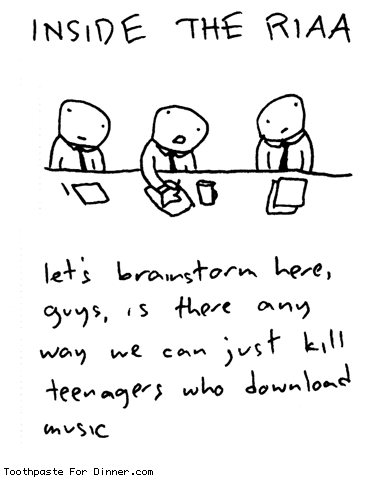
Have the recording industry's evil minions scared you off of swapping tunes online? Tremble in fear no more. There are plenty of ways to legally share music across the Internet, far from the clutches of the RIAA's attorneys.
Music-sharing sites also provide a great way to connect with people who share your excellent musical taste, as well as to get recommendations for new music that you'll like just as much. You might even make a few friends along the way.
Here's how...
Subscribe to:
Posts (Atom)
